
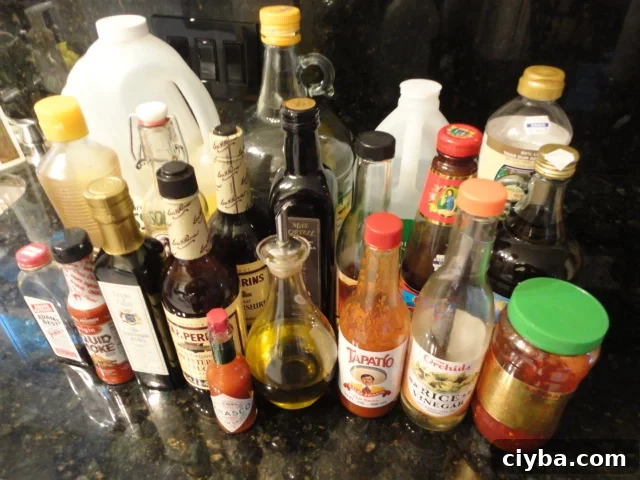
After revisiting my spice rack inventory, I turned my attention to the condiments stored across the pantry, kitchen cabinets and refrigerator. Once I took stock of everything, I could only shake my head. The photo here shows just a small portion of the condiments crowding my kitchen.
What exactly is a condiment?
The term generally refers to substances that add taste — flavor, seasoning or spice. Historically, “condiment” described seasoned, pickled or preserved foods in Latin. Today the definition covers a wide range of items: spices, herbs, sauces, seasonings, flavorings, colorings and even some beverages. One concise explanation groups condiments into five broad, nonexclusive categories: Salt, Sweetener, Pickle, Spicy/Hot and Compound.
Using those categories as a guide, I organized my collection. Some items fit more than one category, but I placed each where it made the most sense to me.
Salt:
Bouillon cubes (beef), bouillon cubes (chicken), bouillon cubes (tomato with chicken), bouillon cubes (vegetable), bouillon paste (mushroom).
Sweet:
Eel sauce, honey, homemade marmalade, molasses, creamy peanut butter, apricot preserves, strawberry preserves, breakfast syrup.
Pickle:
Lemon juice, balsamic vinegar (three bottles), red vinegar, rice vinegar, white vinegar.
Spicy / Hot:
Ground horseradish, Tapatio hot sauce, Tabasco, Chinese hot mustard, deli brown mustard, honey mustard, horseradish mustard, sambal oelek, wasabi sauce.
Compound:
Ketchup, liquid smoke, Marmite, Dijon mayonnaise, Hellmann’s mayonnaise, sandwich-shop mayonnaise, oyster sauce, soy sauce, Thousand Island dressing, Worcestershire sauce, vanilla extract.
I wasn’t sure where to place oils, so I added a sixth category:
Oil:
Extra virgin olive oil (two bottles), sesame oil, vegetable oil.
Many condiments overlap categories—for example, some sauces are both salty and sweet—but this grouping helped make sense of the jumble. There’s also a seventh concept, umami (a uniquely savory taste), that could be treated separately; I’ll explore that in a future post.
A few things stood out while I inventoried my collection. First, I have far too many types of mayonnaise. How did that happen? Mustard varieties are likewise abundant. The most puzzling was the balsamic vinegar: three bottles of something I don’t particularly enjoy. I suspect a couple arrived as “regifts” from others trying to unload extras.
The Thousand Island dressing is the only salad dressing in the fridge, and it’s not generally used for salads but for homemade Reuben sandwiches.
So which condiments do I actually reach for most often?
My go-to list includes Hellmann’s mayonnaise, deli brown mustard, sambal oelek, Marmite, oyster sauce, soy sauce, liquid smoke, Worcestershire sauce, mushroom bouillon paste and olive oil.
Interestingly, despite a sweet tooth, the sweet category items rarely feature in my cooking.
Condiments—like herbs and spices—are tools for transforming and elevating food. Whether added to a sandwich, used to marinate meat or stirred into soup, their purpose is to enhance flavor, texture and the overall eating experience.