

One of the most common questions I hear is, “Help — I crave sweets after dinner every night! What can I do?” In this article I explain why evening sweet cravings happen and share practical tips to help you manage them.

Many of my one-on-one clients and students in my Nutrition Training Program report an internal struggle with wanting sweets after dinner. I understand — it’s a very common experience.
Yes, I’m human — I get it!
It can feel hard to resist sweets after a meal because craving something sweet at the end of a meal is completely normal. If the desire feels manageable and fits your goals, it’s not something that necessarily needs to be changed. If it feels out of control, that’s worth addressing.
Go from mindless snacker who often overeats and feels out of control around food to a confident, balanced eater — without dieting — with the Binge to Balanced Guidebook.

For many people, a sweet signals the end and closure of a meal. It can feel like the final step that completes the experience.
Common reasons you may crave sweets after dinner (or any meal):
1. It’s physiological — digestion requires energy
Your body may signal a desire for something sweet as a way to get a quick burst of energy to support digestion. Breaking down food uses energy, a concept known as the Thermal Effect of Food (TEF). Depending on the macronutrient composition, digestion can consume roughly 3–30% of the calories in the food you eat. This process uses energy to ultimately make energy available to your body, so a post-meal energy craving is not unusual.
2. It’s psychological — post-meal sweets can be a habit
For many people, the more likely reason for nightly sweet cravings is habit. Over time, consistently eating something sweet after a meal becomes an automatic routine: your brain learns to expect dessert as part of finishing a meal. That learned pattern can create a generalized desire for something sweet even when you don’t have a specific item in mind.
To decide if this is a habit you want to change, ask yourself:
- How do I feel after eating sweets regularly?
- Does frequent dessert fit my health and wellness goals?
If sweets after dinner leave you feeling sluggish, bloated, or low-energy, you might choose to rework your routine. If they leave you satisfied and energized, you don’t have to change anything.
Am I eating too much sugar?
If most of your diet is balanced — plenty of vegetables, adequate protein, healthy fats, and fiber-rich carbohydrates — occasional desserts are unlikely to push you into excessive added sugar intake. Over-restriction often increases craving, so allowing reasonable portions can help. Dietary guidelines suggest keeping added sugars low: historically under 10% of daily calories, and some guidance recommends aiming closer to 6%.
Reducing added sugar is sensible, but so is satisfying cravings in a controlled way so you don’t overeat later.
If you want sweets but nothing specific, it’s likely habit rather than a true craving.
How to break the habit of eating sweets after dinner
Three steps to interrupt the habit
- Determine whether your after-dinner craving is a habit or a specific craving.
- Identify the cue, routine, and reward that keep the habit going.
- Change the routine while keeping the cue and reward intact.
Here’s how to apply those steps.
First, observe your behavior.
For a few days, notice when the craving begins. Is it immediate after clearing the table or later while watching TV? Do you want a specific item such as chocolate, or a vague “something sweet”? If you cannot name a specific food, it’s likely a habitual pattern rather than a specific craving.
If it’s a habit and it interferes with your goals, you can interrupt it. Remember, though, many people can include a small daily sweet within a healthy, balanced diet without negative effects.
Second, identify the trigger and the reward.
Habits follow a loop: cue, routine, reward. Finishing dinner may be the cue that initiates your dessert routine, and the reward could be an energy boost, pleasure from taste, or a serotonin/dopamine lift. Identifying the true reward matters because any new routine you adopt should deliver the same or a similar reward.
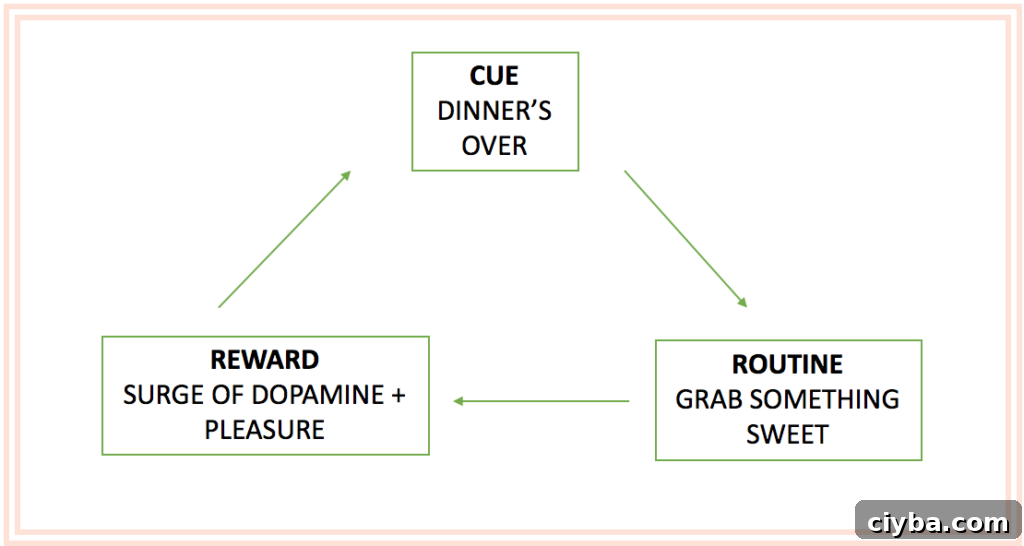
The reward varies. If you’re under-eating during the day, the reward may be calories. If you seek comfort or a mood lift, the reward may be the pleasant feelings sweets provide. Be specific about your personal reward when planning changes.
Third, interrupt the routine.
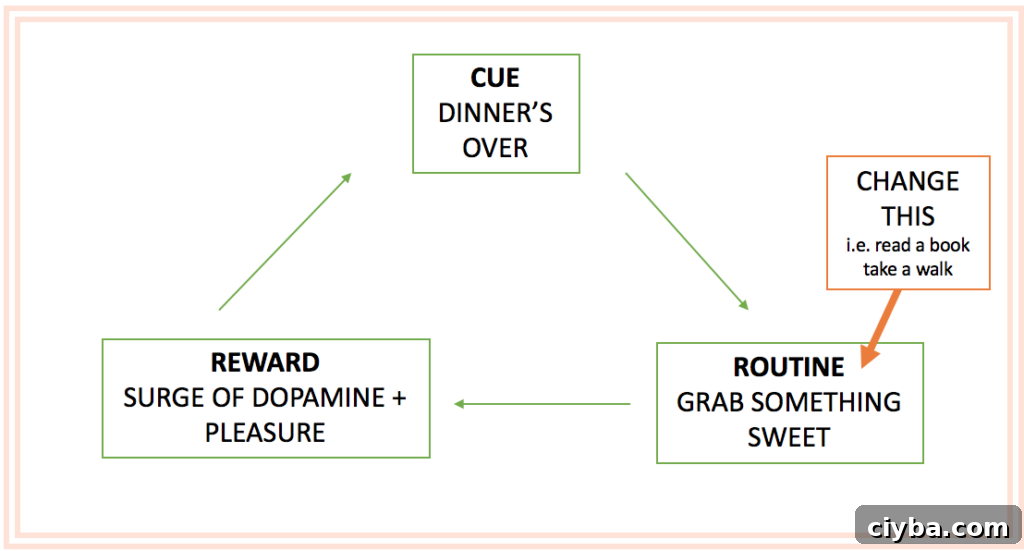
Researchers note that to break a habit, you must change the routine that follows the cue. This is often the most challenging step because habits are strongly reinforced over time. If you typically reach for chocolate right after dinner, replace that action with a different, pleasurable activity that still delivers a reward: take a short walk, do the dishes, read a chapter of a book, or enjoy a warm cup of herbal tea. At first it will feel awkward, but repeating the new routine will gradually rewire the habit.
Make sure the cue (finishing dinner) and the reward (a pleasant feeling or energy boost) remain constant while you test new routines. Choose replacements that are enjoyable so the new loop is sustainable.
Other factors to consider
Several modifiable factors can influence post-dinner sweet cravings. Consider the following:
If you wonder why you crave sweets after dinner, reflect on:
- Are you eating enough during the day? If you under-fuel, hunger hormones like ghrelin increase and can intensify sweet cravings.
- Are your meals balanced? Including carbohydrates, protein, and healthy fats helps promote satisfaction and reduce cravings.
- Do you give yourself permission to enjoy sweets? Restricting treats often heightens desire; allowing controlled portions can reduce obsessive cravings.
- Do you allow yourself sweets at other times? If you deny dessert at breakfast or lunch, the postponed desire can grow and trigger stronger cravings later.
- Are you stressed? Stress can raise hunger signals and increase cravings.
- Are you getting enough sleep? Poor sleep can elevate hunger hormones and cravings.
- Are your meals satisfying? Unsatisfying meals invite more frequent desire for quick pleasure and energy.
- Are you truly practicing unregulated permission to eat what you want when you want? Often giving yourself genuine permission reduces the power of cravings.
Need help getting started?
If you’d like guidance on breaking this habit, feel free to reach out by email and tell me how I can help. This topic is also covered in depth in the Nutrition Training Program.
XO